Aug 30, 2024 | News
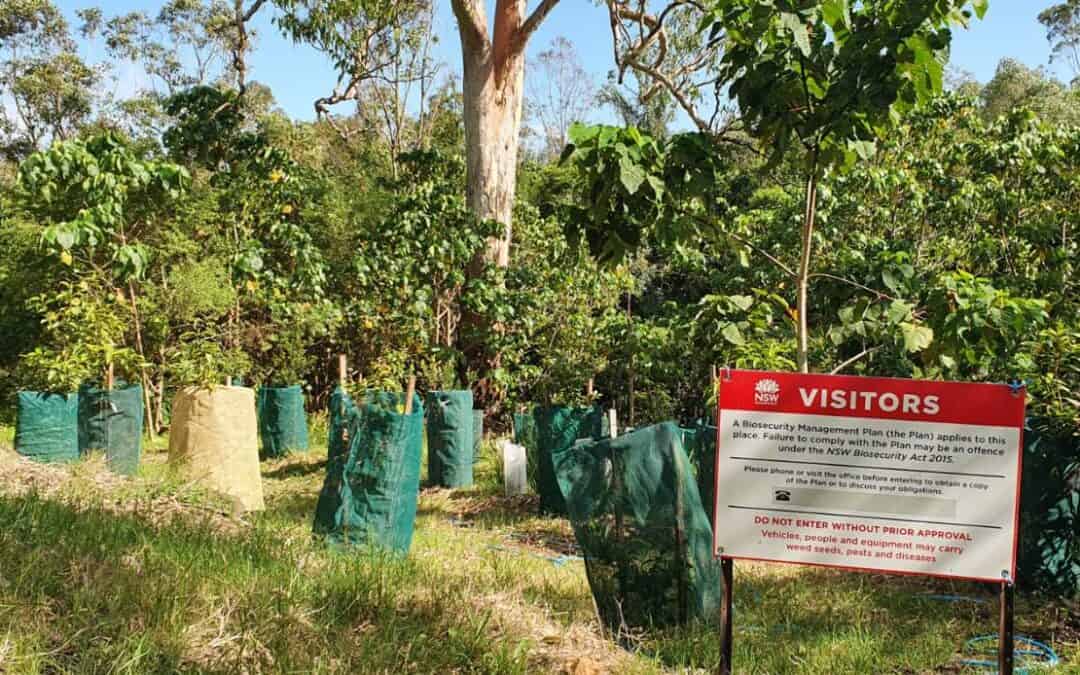
 The NSW Department of Climate Change, Energy, the Environment and Water funded an extension to the ‘Safe Custody for Native Guava‘ project for the 2023/24 financial year, with the following results:
- Continued monitoring of the already-dispersed Native Guava (Rhodomyrtus psidioides) collection, with all plants in excellent health and fruit production at 3 of 5 locations.
- A total of 91 plants from 34 unique genetic lineages of Native Guava have now been dispersed to partner gardens.
- A total of 16 plants from 8 genetic lineages of Scrub Turpentine (Rhodamia rubescens) were dispersed to 5 gardens including new partner Booderee Botanic Gardens.
- Continued integration of germplasm collection, dispersal and monitoring activities between QLD and NSW, including collection of genetic material from healthy R. psidioides appearing in response to drying climate.
- Continued and improved EpiCollect app training and monitoring of the ex situ collections at all partner locations enabling spatial aggregation of flowering, fruiting and health data.
- Collection of Native Guava and Scrub Turpentine fruit being sent to Botanic Gardens of Sydney for storage and viability testing.
- Genetic material collected from healthy Rhodamia maideniana and Rhodamia whiteana plants observed in the field and sent for additional genetic analysis.
- Ongoing monthly meetings of the Myrtle Rust Consortium where members networked and shared information, discussed issues and lessons, gave presentations and reported on germplasm collection, propagation, planting, research findings and maintenance of the ex situ collections. It also facilitated the submission of collaborative grant applications.
- Collaboration with UNSW and the BGANZ Collections and Records Management group (BCARM) on a quarterly series of informal virtual get togethers, the “Myrtle Rust Management for Practitioners – open series” which commenced in February 2024, focusing on practical aspects of managing and maintaining a conservation collection of Myrtle Rust susceptible species.
- Updating of the ANPC’s Myrtle Rust Hub.
- Updating of the Myrtle Rust ID and collection methods brochure.
- Development of an outreach partner garden flyer explaining the project, for the general public when visiting the ex situ collections and which can be used for guided walks.
- Flyer explaining ReCER resistance screening trial was developed and installed at ABG Mt Annan
- Preparation to publish a paper on the establishment of emergency conservation collections and subsequent dispersal of safe meta collections which is, to our knowledge, undocumented in publicly accessible literature.
The planting of the collections in-ground has been extremely successful with only 3 deaths reported from the 107 distributed plants, with these replaced. All deaths were accidental/human induced, one due to watering failure, one was broken during transit and a third damaged by grazing after fence damage.
EpiCollect monitoring over the course of the project determined that control of Myrtle Rust infection was very successful but frequent application of fungicide was required in the high infection zones. Monthly monitoring reported 77 instances of planted Native Guava plants flowering (the majority of which occurred in Summer 2023) and 128 instances of fruit production (the majority of which were in Summer and Autumn 2023). 22 of these fruits were mature. A total of 6 Scrub Turpentine fruit were recorded (2 in Summer and 4 in Autumn 2024) and 1 instance of flowering was recorded. The production and collection of mature fruit will be critical to the conservation of both these species.
ANPC Project Manager Chantelle Doyle coordinated this project.
Read this Botanic Gardens of Sydney blog piece written by Chantelle to find out more about how ‘genetics is helping to save plant species decimated by myrtle rust’ dated 28 July 2023.
Thank you to all our partner organisations for their generous support and commitment to this project:


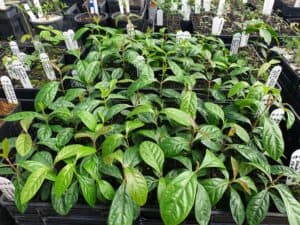
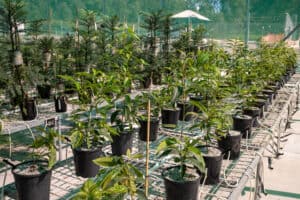
Main image: Native Guava plants at Lismore Rainforest Botanic Gardens. Credit: Chantelle Doyle


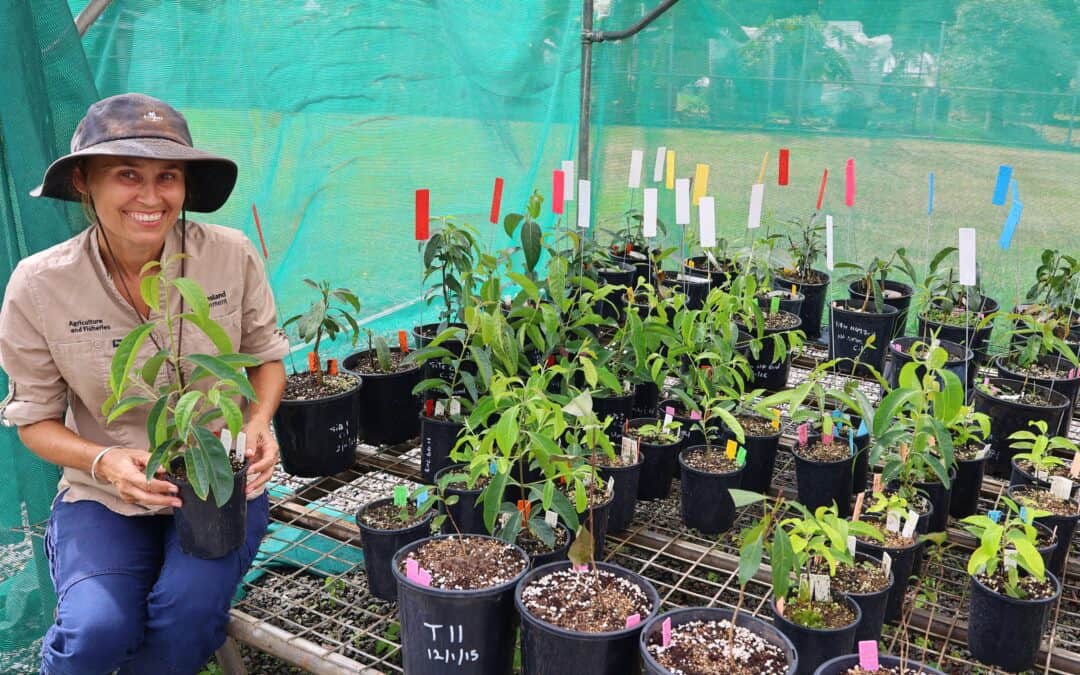
Native Guava plants growing at the Australian Botanic Garden Mt Annan before dispersal. Credits: Veronica Viler (L) and Nathan Emery
Dec 22, 2023 | Events Category
There is a need for horticulturists and practitioners managing Myrtle Rust susceptible collections to collaborate, share ideas and workshop problems.
To address this the ANPC, UNSW and the BGANZ Collections and Records Management group (BCARM) are collaborating to co-ordinate a quarterly series of informal virtual get togethers, commencing in February 2024.
This series will be exclusively focused on practical aspects of managing and maintaining a conservation collection of Myrtle Rust susceptible species and will have an open forum structure. The series will be open to any practitioners across Australia and Aotearoa New Zealand managing collections impacted by Myrtle Rust including local council nurseries.
As part of customising the content and schedule we are seeking your feedback in this short survey.
The first session “Fundamentals of managing a Myrtle Rust sensitive collection” will be held on 22 February 2024 at 2pm Australian Eastern Daylight Time (AEDT).
REGISTER HERE!
For more information about Myrtle Rust visit the dedicated ANPC resource page.
We hope to see you there.
Aug 31, 2023 | News
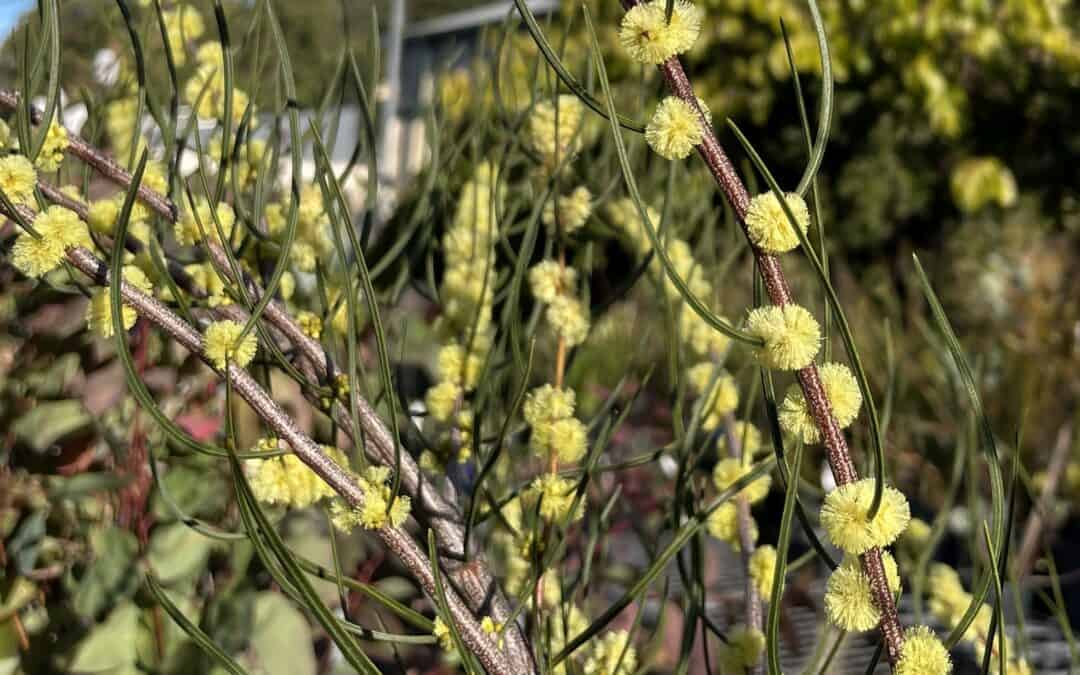
A behind the scenes look at the small conservation collection of Acacia phasmoides (Phantom wattle), which has just started flowering in the Royal Botanic Gardens Victoria (RBGV) nursery. The Phantom wattle only occurs on Pine Mountain, in northeast Victoria, and Woomargama in NSW. This species is federally listed as Vulnerable and is at risk of local extinction due to unpredictable natural threats, including severe floods or fire.
RBGV conservation geneticists are analysing genetic data to guide ex situ conservation of the Phantom wattle, which will include collections for the Victorian Conservation Seedbank and propagation of additional plants to build the conservation collection.
Holding seed and plants ex situ acts as insurance against the loss of wild populations and forms part of the Preventing the extinction of Victoria’s threatened flora project. RBGV botanists will be joined by members of the local community when undertaking surveys and collecting the plants.
This research is funded by DEECA’s Victoria’s Nature Fund. The ‘Preventing the extinction of Victoria’s threatened flora’ project is led by Royal Botanic Gardens Victoria in partnership with La Trobe University, Australian Network for Plant Conservation, DEECA, Trust for Nature, ENVITE, Bairnsdale & District Field Naturalists Club, Friends of the Grampians Gariwerd, Wimmera CMA, Nillumbik Shire, Halls Gap Botanic Gardens and the Australasian Native Orchid Society Victorian Branch
Image: Acacia phasmoides growing in the RBGV nursery. (Laura Simmons)
Jul 28, 2023 | News
Australia lacks the seed supplies, knowledge for nature repair market, experts say – Carbon Pulse, 26 July 2023
“The ANPC has identified a “high level of concern” across the native seed sector that future demand for seed would be difficult to meet from the wild.
“This is due to the high costs of seed collection and the lack of seed from a broad range of the species that are critical for restoration.
“There may not be enough native seed in many regions to support the large-scale restoration required for landscape recovery.
“The ANPC said the further development and funding of seed production areas – where native species are cultivated for their seeds, like agricultural crops – would be critical to meeting seed needs and preserving wild populations.
“High quality seed from a range of native species is the foundation for restoring many of our threatened plants and natural landscapes.”
Read the full article here.
Download the ANPC’s Australian Native Seed Survey Report for more information on this issue.
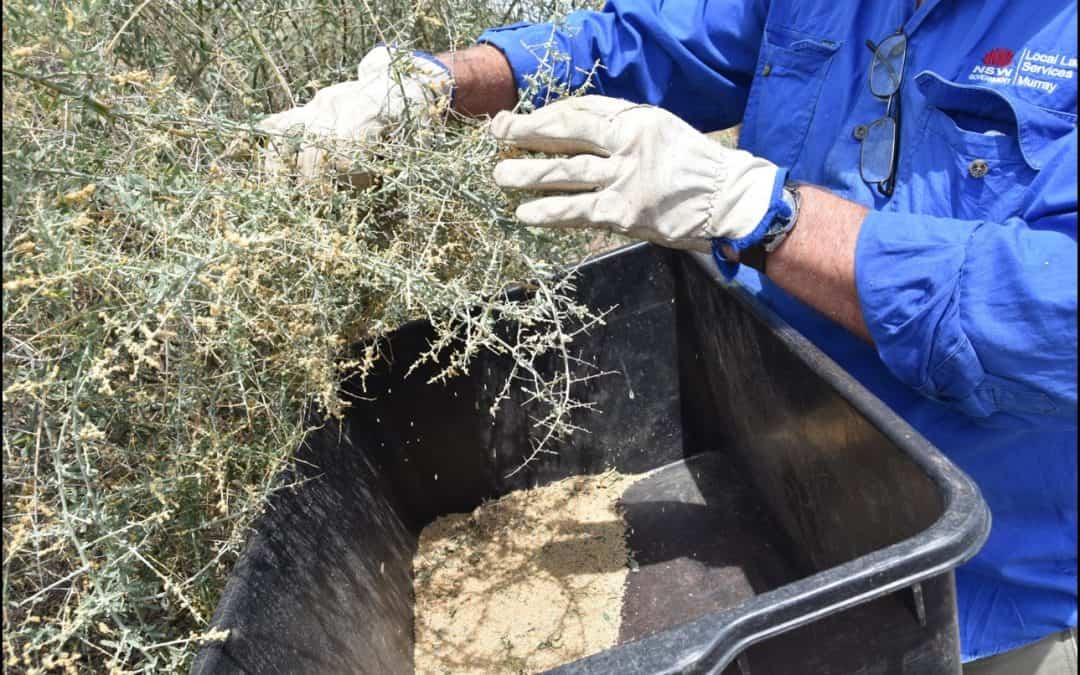
Image: Collecting Nitre Goosefoot (Chenopodium nitrariaceum) seed (Sue Logie)
Jul 28, 2023 | News
Thanks to funding from DEECA Victoria’s Nature Fund,
Royal Botanic Gardens Victoria will be leading research to conserve 24 threatened Victorian plant species as part of the ‘Preventing the extinction of Victoria’s threatened flora’ project. Stay tuned over the next year to hear more about the incredible plants being conserved for future generations.
One of these plants, and the first to be featured over the next 12 months, is
Spyridium furculentum (forked spyridium).

Considered Critically Endangered in Victoria under the Flora and Fauna Guarantee Act, this rare species is endemic to heathy mallee in western Victoria – where it is only known from a few locations.
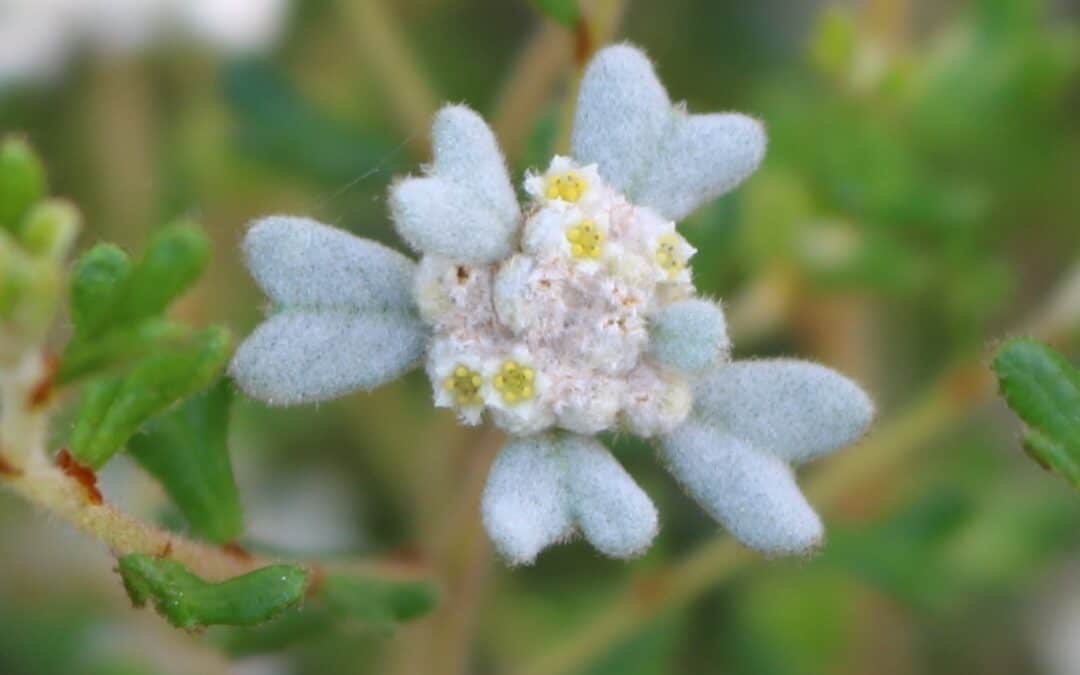
Forked spyridium is a shrub that grows to approximately 1.6 m tall, and the young branches are covered with star-shaped (stellate) hairs giving them a soft, furry appearance.
Ahead of field work later this year when populations will be surveyed and samples collected to characterise the genetic diversity of those populations, scientists are investigating seed viability and germination of seed collections held in the Victorian Conservation Seedbank (VCS) at Royal Botanic Gardens Victoria.
The VCS holds collections of over 880 rare and threatened Victorian plant species for long-term conservation and this includes nine collections of Spyridium furculentum made since 2004. Like many species in the family Rhamnaceae, seeds of forked spyridium have a hard seed coat which acts as a physical barrier to water uptake and germination, so a dry heat treatment will be used to break this physical dormancy and enable germination. Seedlings will then be grown on to bolster populations in the wild.
This project is led by Royal Botanic Gardens Victoria in partnership with La Trobe University, Australian Network for Plant Conservation, DEECA, Trust for Nature, ENVITE, Bairnsdale & District Field Naturalists Club, Friends of the Grampians Gariwerd, Halls Gap Botanic Gardens and the Australasian Native Orchid Society Victorian Branch.
Image: Jo Lynch

 The NSW Department of Climate Change, Energy, the Environment and Water funded an extension to the ‘Safe Custody for Native Guava‘ project for the 2023/24 financial year, with the following results: